
Chemistry Lab Display Charts Manufacturer,Supplier and Exporter in India
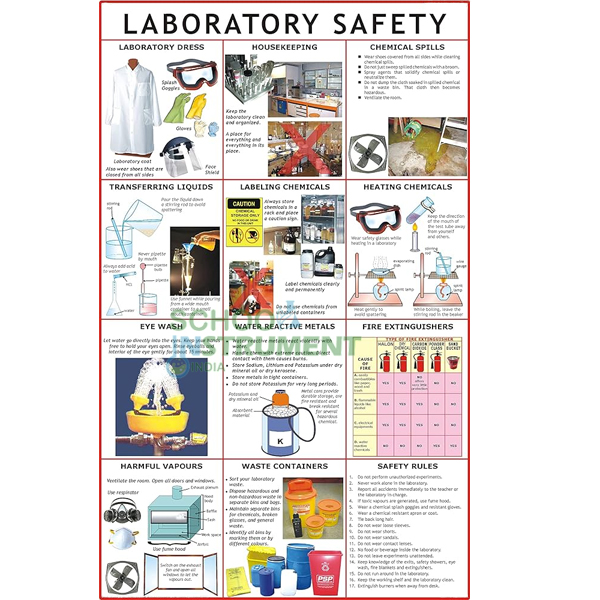
Product Code : SCL-ELE-11772
The School Instrument Chemistry Laboratory Display Chart is
a clinical-grade instructional instrument designed for University, Secondary,
and Vocational science departments. Calibrated for high-use laboratory
environments, these 70x100 cm charts facilitate technical mastery of chemical
safety, apparatus handling, and reaction mechanisms. Compliant with ISO
9001:2015 standards, the synthetic substrate ensures chemical resistance and
long-term dimensional stability.
Technical Specifications
|
Tender Specification |
OEM Technical Detail |
|
Material Grade |
Tear-Resistant Reinforced
Synthetic Polymer |
|
Surface Finish |
Non-Reflective Matte
(Chemical & Splash Resistant) |
|
Dimensions |
700 mm x 1000 mm (Large
Format Display) |
|
Mounting Hardware |
Integrated Industrial-Grade
Plastic Rollers (Top & Bottom) |
|
Linguistic Protocol |
Technical English
(Standardized IUPAC Nomenclature) |
Key Pedagogical Outcomes
·
High-Resolution
Apparatus Schematics: Enables students to identify and
assemble complex distillation and titration setups, supporting (Knowledge) of laboratory hardware.
·
GHS-Compliant Chemical
Hazard Symbols: Facilitates the immediate recognition of reactive
hazards and safety protocols, supporting (Application) of
lab safety standards.
·
Detailed Reaction
Mechanism Mapping: Allows for the visual analysis of
electron transfer and molecular bonding, supporting (Analysis) of
organic and inorganic chemistry modules.
International Logistics & Compliance
Our export division
specializes in high-volume institutional procurement and international tender
fulfillment. All units are secured in export-grade seaworthy crating
(ISPM-15 compliant) to protect the synthetic substrate during
multi-modal transit. Documentation packages include the Manufacturer’s Authorization Form (MAF), IQ/OQ/PQ
Certification, and User Manuals in English. The tropicalized design
is batch-tested for operational stability in temperatures up to 45°C and 90% humidity, ensuring the charts remain
resistant to fungal growth and pigment degradation in tropical laboratory
settings.


.jpg)

