Cockroach Charts, Zoology Manufacturer,Supplier and Exporter in India
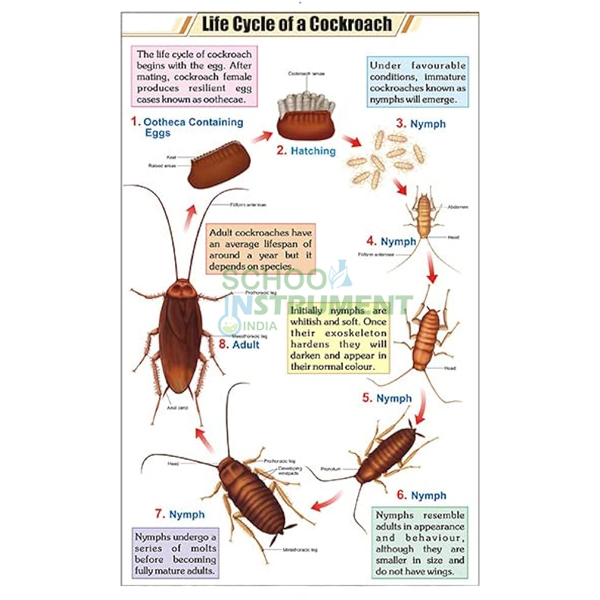
Product Code : SCL-ELE-11774
The School Instrument Cockroach Morphology Chart is a
high-fidelity anatomical visualization tool engineered for Secondary and
University-level Zoology laboratories. This instrument facilitates the forensic
analysis of arthropod physiology and internal systems in accordance with ISO
9001:2015 manufacturing standards. Utilizing a 58x90 cm laminated substrate
with integrated plastic rollers, it provides a ruggedized solution for
high-frequency laboratory practicals and biological demonstrations.
Technical Specifications
|
Tender Specification |
OEM Technical Detail |
|
Material Grade |
150-170 GSM High-Opacity Art
Paper |
|
Surface Finish |
Dual-Sided Thermal BOPP
Lamination |
|
Dimensions |
580 mm x 900 mm (Standard
Technical Format) |
|
Mounting Hardware |
Impact-Resistant Integrated
Plastic Rollers (Top & Bottom) |
|
Linguistic Protocol |
Technical English
(Standardized Biological Nomenclature) |
Key Pedagogical Outcomes
·
Technically Accurate Anatomical Labeling: Enables students to identify the head, thorax,
abdomen, and specialized appendages, supporting (Knowledge) of
arthropod taxonomy.
·
High-Contrast Internal System Rendering: Facilitates the analysis of the digestive,
circulatory, and nervous systems, supporting (Analysis) of
comparative physiology.
·
Detailed Reproductive and Respiratory
Schematics: Allows students to explain the mechanisms of
tracheole respiration and lifecycle stages, supporting (Comprehension) of biological processes.
International Logistics & Compliance
Our export protocols
are optimized for large-scale institutional tenders and global distribution.
Consignments are secured in export-grade seaworthy crating
(ISPM-15 compliant) to mitigate structural stress during multi-modal
transit. Comprehensive documentation is included: Manufacturer’s Authorization
Form (MAF), IQ/OQ/PQ Certification, and User Manuals in English. The
hardware features a tropicalized design, batch-tested
for operational stability in environments reaching 45°C and 90% humidity,
ensuring the charts remain resistant to fungal growth and substrate warping.